

What Kind Of Formula Tells The Exact Makeup Of 1 Molecule Of A Molecular Compound
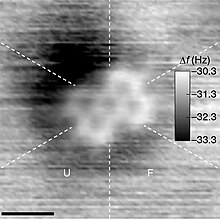


AFM image of 1,5,9-trioxo-13-azatriangulene and its chemic structure.[3]
A molecule is a group of 2 or more atoms held together by attractive forces known as chemical bonds; depending on context, the term may or may non include ions which satisfy this criterion.[iv] [v] [6] [7] [8] In breakthrough physics, organic chemistry, and biochemistry, the stardom from ions is dropped and molecule is ofttimes used when referring to polyatomic ions.
In the kinetic theory of gases, the term molecule is often used for any gaseous particle regardless of its composition. This relaxes the requirement that a molecule contains two or more atoms, since the noble gases are individual atoms.[9]
A molecule may be homonuclear, that is, it consists of atoms of one chemical chemical element, due east.g. two atoms in the oxygen molecule (O2); or it may be heteronuclear, a chemical chemical compound composed of more than than one element, east.thou. water (2 hydrogen atoms and one oxygen atom; H2O).
Atoms and complexes connected by non-covalent interactions, such as hydrogen bonds or ionic bonds, are typically not considered unmarried molecules.[10]
Molecules as components of matter are mutual. They also make upwards near of the oceans and atmosphere. Most organic substances are molecules. The substances of life are molecules, e.one thousand. proteins, the amino acids of which they are composed, the nucleic acids (DNA and RNA), sugars, carbohydrates, fats, and vitamins. The nutrient minerals are more often than not ionic compounds, thus they are non molecules, e.thou. fe sulfate.
However, the bulk of familiar solid substances on Earth are fabricated partly or completely of crystals or ionic compounds, which are not made of molecules. These include all of the minerals that make upwards the substance of the Earth, sand, clay, pebbles, rocks, boulders, bedrock, the molten interior, and the cadre of the Earth. All of these contain many chemical bonds, but are not made of identifiable molecules.
No typical molecule tin can exist defined for salts nor for covalent crystals, although these are often composed of repeating unit of measurement cells that extend either in a aeroplane, eastward.g. graphene; or iii-dimensionally eastward.one thousand. diamond, quartz, sodium chloride. The theme of repeated unit-cellular-structure also holds for most metals which are condensed phases with metal bonding. Thus solid metals are not made of molecules.
In spectacles, which are solids that exist in a vitreous disordered land, the atoms are held together past chemical bonds with no presence of any definable molecule, nor whatever of the regularity of repeating unit-cellular-construction that characterizes salts, covalent crystals, and metals.
Molecular scientific discipline
The science of molecules is chosen molecular chemistry or molecular physics, depending on whether the focus is on chemical science or physics. Molecular chemistry deals with the laws governing the interaction between molecules that results in the formation and breakage of chemical bonds, while molecular physics deals with the laws governing their structure and properties. In practice, yet, this distinction is vague. In molecular sciences, a molecule consists of a stable arrangement (leap state) equanimous of two or more atoms. Polyatomic ions may sometimes exist usefully thought of equally electrically charged molecules. The term unstable molecule is used for very reactive species, i.e., curt-lived assemblies (resonances) of electrons and nuclei, such as radicals, molecular ions, Rydberg molecules, transition states, van der Waals complexes, or systems of colliding atoms equally in Bose–Einstein condensate.
History and etymology
According to Merriam-Webster and the Online Etymology Lexicon, the word "molecule" derives from the Latin "moles" or pocket-size unit of mass.
- Molecule (1794) – "extremely minute particle", from French molécule (1678), from New Latin molecula, atomic of Latin moles "mass, bulwark". A vague significant at kickoff; the faddy for the discussion (used until the belatedly 18th century just in Latin grade) can exist traced to the philosophy of Descartes.[eleven] [12]
The definition of the molecule has evolved as knowledge of the structure of molecules has increased. Earlier definitions were less precise, defining molecules as the smallest particles of pure chemical substances that nevertheless retain their composition and chemical properties.[13] This definition often breaks downward since many substances in ordinary feel, such as rocks, salts, and metals, are composed of large crystalline networks of chemically bonded atoms or ions, but are not fabricated of discrete molecules.
Bonding
Molecules are mostly held together by covalent bonding. Several non-metallic elements exist simply every bit molecules in the environment either in compounds or as homonuclear molecules, not as free atoms: for case, hydrogen.
While some people say a metallic crystal can be considered a single behemothic molecule held together past metallic bonding,[fourteen] others point out that metals deport very differently than molecules.[15]
Covalent
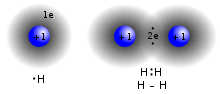
A covalent bail forming Hii (right) where 2 hydrogen atoms share the two electrons
A covalent bond is a chemical bond that involves the sharing of electron pairs between atoms. These electron pairs are termed shared pairs or bonding pairs, and the stable balance of bonny and repulsive forces between atoms, when they share electrons, is termed covalent bonding.[16]
Ionic
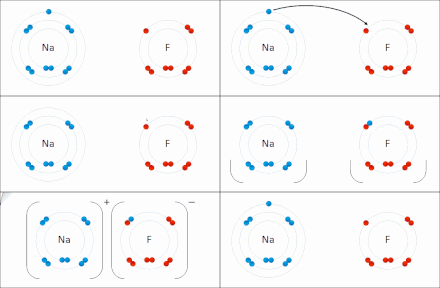
Ionic bonding is a blazon of chemic bond that involves the electrostatic attraction between oppositely charged ions, and is the primary interaction occurring in ionic compounds. The ions are atoms that have lost one or more electrons (termed cations) and atoms that have gained one or more electrons (termed anions).[17] This transfer of electrons is termed electrovalence in contrast to covalence. In the simplest case, the cation is a metal atom and the anion is a nonmetal atom, only these ions tin be of a more complicated nature, eastward.chiliad. molecular ions like NH4 + or Then4 two−. At normal temperatures and pressures, ionic bonding mostly creates solids (or occasionally liquids) without split identifiable molecules, but the vaporization/sublimation of such materials does produce carve up molecules where electrons are nevertheless transferred fully plenty for the bonds to be considered ionic rather than covalent.
Molecular size
Most molecules are far besides small to be seen with the naked eye, although molecules of many polymers tin attain macroscopic sizes, including biopolymers such as DNA. Molecules commonly used as edifice blocks for organic synthesis have a dimension of a few angstroms (Å) to several dozen Å, or around one billionth of a meter. Single molecules cannot usually exist observed by light (as noted above), but small-scale molecules and even the outlines of private atoms may exist traced in some circumstances by apply of an atomic forcefulness microscope. Some of the largest molecules are macromolecules or supermolecules.
The smallest molecule is the diatomic hydrogen (H2), with a bond length of 0.74 Å.[eighteen]
Effective molecular radius is the size a molecule displays in solution.[19] [20] The table of permselectivity for different substances contains examples.
Molecular formulas
Chemic formula types
The chemical formula for a molecule uses ane line of chemical element symbols, numbers, and sometimes also other symbols, such as parentheses, dashes, brackets, and plus (+) and minus (−) signs. These are express to one typographic line of symbols, which may include subscripts and superscripts.
A compound's empirical formula is a very simple type of chemic formula.[21] It is the simplest integer ratio of the chemical elements that institute it.[22] For example, water is always equanimous of a 2:i ratio of hydrogen to oxygen atoms, and ethanol (ethyl alcohol) is always equanimous of carbon, hydrogen, and oxygen in a 2:6:1 ratio. However, this does not make up one's mind the kind of molecule uniquely – dimethyl ether has the aforementioned ratios as ethanol, for instance. Molecules with the same atoms in different arrangements are called isomers. Also carbohydrates, for example, take the same ratio (carbon:hydrogen:oxygen= 1:2:1) (and thus the same empirical formula) but unlike total numbers of atoms in the molecule.
The molecular formula reflects the exact number of atoms that compose the molecule and so characterizes different molecules. However unlike isomers can have the same diminutive composition while being different molecules.
The empirical formula is frequently the same as the molecular formula but not always. For example, the molecule acetylene has molecular formula C2H2, but the simplest integer ratio of elements is CH.
The molecular mass tin can be calculated from the chemic formula and is expressed in conventional atomic mass units equal to ane/12 of the mass of a neutral carbon-12 (12C isotope) atom. For network solids, the term formula unit is used in stoichiometric calculations.
Structural formula
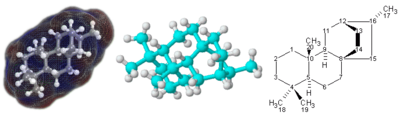
3D (left and center) and 2D (right) representations of the terpenoid molecule atisane
For molecules with a complicated 3-dimensional construction, especially involving atoms bonded to four different substituents, a simple molecular formula or even semi-structural chemical formula may non exist enough to completely specify the molecule. In this case, a graphical blazon of formula called a structural formula may exist needed. Structural formulas may in turn be represented with a one-dimensional chemical name, simply such chemical nomenclature requires many words and terms which are non part of chemical formulas.
Molecular geometry
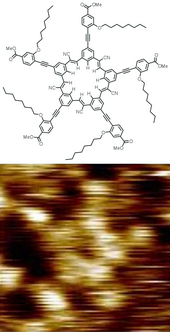
Molecules take fixed equilibrium geometries—bond lengths and angles— about which they continuously oscillate through vibrational and rotational motions. A pure substance is equanimous of molecules with the same average geometrical structure. The chemic formula and the structure of a molecule are the two important factors that make up one's mind its backdrop, peculiarly its reactivity. Isomers share a chemical formula merely usually have very unlike properties because of their dissimilar structures. Stereoisomers, a detail type of isomer, may have very similar physico-chemic properties and at the aforementioned time dissimilar biochemical activities.
Molecular spectroscopy
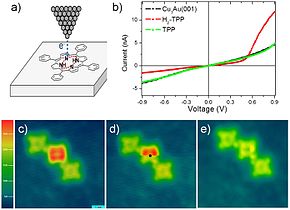
Hydrogen tin can be removed from individual H2TPP molecules by applying excess voltage to the tip of a scanning tunneling microscope (STM, a); this removal alters the current-voltage (I-V) curves of TPP molecules, measured using the same STM tip, from diode similar (cherry curve in b) to resistor like (greenish curve). Prototype (c) shows a row of TPP, HtwoTPP and TPP molecules. While scanning image (d), excess voltage was applied to H2TPP at the black dot, which instantly removed hydrogen, as shown in the bottom role of (d) and in the rescan image (e). Such manipulations can be used in single-molecule electronics.[24]
Molecular spectroscopy deals with the response (spectrum) of molecules interacting with probing signals of known energy (or frequency, according to Planck's formula). Molecules have quantized free energy levels that tin be analyzed by detecting the molecule'south energy commutation through absorbance or emission.[25] Spectroscopy does not generally refer to diffraction studies where particles such every bit neutrons, electrons, or loftier energy X-rays interact with a regular arrangement of molecules (equally in a crystal).
Microwave spectroscopy ordinarily measures changes in the rotation of molecules, and can exist used to place molecules in outer infinite. Infrared spectroscopy measures the vibration of molecules, including stretching, bending or twisting motions. It is commonly used to identify the kinds of bonds or functional groups in molecules. Changes in the arrangements of electrons yield absorption or emission lines in ultraviolet, visible or near infrared light, and result in colour. Nuclear resonance spectroscopy measures the environment of particular nuclei in the molecule, and can be used to characterise the numbers of atoms in different positions in a molecule.
Theoretical aspects
The study of molecules past molecular physics and theoretical chemistry is largely based on quantum mechanics and is essential for the agreement of the chemic bail. The simplest of molecules is the hydrogen molecule-ion, H2 +, and the simplest of all the chemical bonds is the one-electron bond. H2 + is composed of two positively charged protons and i negatively charged electron, which ways that the Schrödinger equation for the system can exist solved more easily due to the lack of electron–electron repulsion. With the development of fast digital computers, estimate solutions for more complicated molecules became possible and are ane of the main aspects of computational chemistry.
When trying to define rigorously whether an arrangement of atoms is sufficiently stable to be considered a molecule, IUPAC suggests that it "must correspond to a depression on the potential free energy surface that is deep enough to confine at least one vibrational land".[4] This definition does not depend on the nature of the interaction betwixt the atoms, but only on the strength of the interaction. In fact, it includes weakly bound species that would not traditionally be considered molecules, such as the helium dimer, He2, which has one vibrational leap state[26] and is so loosely jump that it is only likely to be observed at very depression temperatures.
Whether or not an arrangement of atoms is sufficiently stable to be considered a molecule is inherently an operational definition. Philosophically, therefore, a molecule is not a fundamental entity (in contrast, for instance, to an unproblematic particle); rather, the concept of a molecule is the chemist's shop way of making a useful statement almost the strengths of atomic-calibration interactions in the world that nosotros observe.
Run across besides
- Cantlet
- Chemical polarity
- Chemical structure
- Covalent bail
- Diatomic molecule
- List of compounds
- List of interstellar and circumstellar molecules
- Molecular biological science
- Molecular design software
- Molecular engineering
- Molecular geometry
- Molecular Hamiltonian
- Molecular ion
- Molecular modelling
- Molecular promiscuity
- Molecular orbital
- Non-covalent bonding
- Periodic systems of small molecules
- Small molecule
- Comparing of software for molecular mechanics modeling
- Van der Waals molecule
- Earth Wide Molecular Matrix
References
- ^ Iwata, Kota; Yamazaki, Shiro; Mutombo, Pingo; Hapala, Prokop; Ondráček, Martin; Jelínek, Pavel; Sugimoto, Yoshiaki (2015). "Chemical structure imaging of a single molecule past atomic strength microscopy at room temperature". Nature Communications. 6: 7766. Bibcode:2015NatCo...six.7766I. doi:10.1038/ncomms8766. PMC4518281. PMID 26178193.
- ^ Dinca, L.E.; De Marchi, F.; MacLeod, J.Yard.; Lipton-Duffin, J.; Gatti, R.; Ma, D.; Perepichka, D.F.; Rosei, F. (2015). "Pentacene on Ni(111): Room-temperature molecular packing and temperature-activated conversion to graphene". Nanoscale. 7 (7): 3263–9. Bibcode:2015Nanos...seven.3263D. doi:ten.1039/C4NR07057G. PMID 25619890.
- ^ Hapala, Prokop; Švec, Martin; Stetsovych, Oleksandr; Van Der Heijden, Nadine J.; Ondráček, Martin; Van Der Lit, Joost; Mutombo, Pingo; Swart, Ingmar; Jelínek, Pavel (2016). "Mapping the electrostatic force field of single molecules from loftier-resolution scanning probe images". Nature Communications. vii: 11560. Bibcode:2016NatCo...711560H. doi:ten.1038/ncomms11560. PMC4894979. PMID 27230940.
- ^ a b IUPAC, Compendium of Chemic Terminology, second ed. (the "Gold Book") (1997). Online corrected version: (2006–) "Molecule". doi:10.1351/goldbook.M04002
- ^ Ebbin, Darrell D. (1990). Full general Chemistry (3rd ed.). Boston: Houghton Mifflin Co. ISBN978-0-395-43302-7.
- ^ Brown, T.Fifty.; Kenneth C. Kemp; Theodore L. Chocolate-brown; Harold Eugene LeMay; Bruce Edward Bursten (2003). Chemistry – the Key Science (9th ed.). New Jersey: Prentice Hall. ISBN978-0-thirteen-066997-one.
- ^ Chang, Raymond (1998). Chemistry (sixth ed.). New York: McGraw Hill. ISBN978-0-07-115221-i.
- ^ Zumdahl, Steven S. (1997). Chemistry (4th ed.). Boston: Houghton Mifflin. ISBN978-0-669-41794-4.
- ^ Chandra, Sulekh (2005). Comprehensive Inorganic Chemical science. New Age Publishers. ISBN978-81-224-1512-4.
- ^ "Molecule". Encyclopædia Britannica. 22 January 2016. Retrieved 23 February 2016.
- ^ Harper, Douglas. "molecule". Online Etymology Dictionary . Retrieved 22 February 2016.
- ^ "molecule". Merriam-Webster . Retrieved 22 February 2016.
- ^ Molecule Definition Archived 13 October 2014 at the Wayback Machine (Frostburg Country University)
- ^ Harry, B. Gray. Chemic Bonds: An Introduction to Atomic and Molecular Structure (PDF). pp. 210–211. Retrieved 22 Nov 2021.
- ^ "How many gold atoms make gold metal?". phys.org . Retrieved 22 November 2021.
- ^ Campbell, Neil A.; Brad Williamson; Robin J. Heyden (2006). Biological science: Exploring Life. Boston: Pearson Prentice Hall. ISBN978-0-13-250882-7 . Retrieved five Feb 2012.
- ^ Campbell, Flake C. (2008). Elements of Metallurgy and Engineering Alloys. ASM International. ISBN978-1-61503-058-3.
- ^ Roger L. DeKock; Harry B. Gray; Harry B. Greyness (1989). Chemical structure and bonding. University Scientific discipline Books. p. 199. ISBN978-0-935702-61-three.
- ^ Chang RL; Deen WM; Robertson CR; Brenner BM (1975). "Permselectivity of the glomerular capillary wall: III. Restricted transport of polyanions". Kidney Int. 8 (4): 212–218. doi:x.1038/ki.1975.104. PMID 1202253.
- ^ Chang RL; Ueki IF; Troy JL; Deen WM; Robertson CR; Brenner BM (1975). "Permselectivity of the glomerular capillary wall to macromolecules. Ii. Experimental studies in rats using neutral dextran". Biophys. J. 15 (9): 887–906. Bibcode:1975BpJ....15..887C. doi:10.1016/S0006-3495(75)85863-ii. PMC1334749. PMID 1182263.
- ^ Wink, Donald J.; Fetzer-Gislason, Sharon; McNicholas, Sheila (2003). The Practice of Chemistry. Macmillan. ISBN978-0-7167-4871-seven.
- ^ "ChemTeam: Empirical Formula". www.chemteam.info . Retrieved xvi April 2017.
- ^ Hirsch, Brandon E.; Lee, Semin; Qiao, Bo; Chen, Chun-Hsing; McDonald, Kevin P.; Tait, Steven L.; Overflowing, Amar H. (2014). "Anion-induced dimerization of five-fold symmetric cyanostars in 3D crystalline solids and 2D self-assembled crystals". Chemic Communications. fifty (69): 9827–30. doi:10.1039/C4CC03725A. PMID 25080328.
- ^ Zoldan, V. C.; Faccio, R; Pasa, A.A. (2015). "Due north and p type character of unmarried molecule diodes". Scientific Reports. 5: 8350. Bibcode:2015NatSR...5E8350Z. doi:ten.1038/srep08350. PMC4322354. PMID 25666850.
- ^ IUPAC, Compendium of Chemical Terminology, 2nd ed. (the "Gold Book") (1997). Online corrected version: (2006–) "Spectroscopy". doi:ten.1351/goldbook.S05848
- ^ Anderson JB (May 2004). "Comment on "An exact quantum Monte Carlo calculation of the helium-helium intermolecular potential" [J. Chem. Phys. 115, 4546 (2001)]". J Chem Phys. 120 (20): 9886–7. Bibcode:2004JChPh.120.9886A. doi:ten.1063/1.1704638. PMID 15268005.
External links
- Molecule of the Month – School of Chemistry, University of Bristol
Source: https://en.wikipedia.org/wiki/Molecule
Posted by: lopezothapprocy.blogspot.com
0 Response to "What Kind Of Formula Tells The Exact Makeup Of 1 Molecule Of A Molecular Compound"
Post a Comment